
The Painful Truth About Wedding Budgets
Nearly half of all couples exceed their wedding budget, with the average overage reaching $5,000-$10,000. This isn't random bad luck—it's the predictable result of specific, avoidable mistakes that the wedding industry quietly relies upon.
The couples who stay on budget aren't luckier or more disciplined. They simply understand how wedding costs spiral and take proactive steps to prevent the most common budget-busting errors. This guide examines each major mistake, explains why it costs money, and provides concrete strategies to avoid it.
The four rentals worth buying instead
Most wedding advice is about trimming the flowers. These four are the line items where buying outright costs less than one night of hire, and three of them resell afterwards.
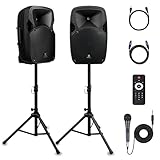 PRORECK Party 12 Powered PA System
A DJ is one of the biggest line items on any wedding budget. If someone you know can run a playlist, this is the difference between hiring one and not.
See it on Amazon →
PRORECK Party 12 Powered PA System
A DJ is one of the biggest line items on any wedding budget. If someone you know can run a playlist, this is the difference between hiring one and not.
See it on Amazon →
 Amazon Basics 46,000 BTU Patio Heater
Outdoor evening receptions live or die on this. Renting three for a night often costs more than buying two.
See it on Amazon →
Amazon Basics 46,000 BTU Patio Heater
Outdoor evening receptions live or die on this. Renting three for a night often costs more than buying two.
See it on Amazon →
 DazzlingStage Wireless Battery Uplights (6)
Battery uplights need no cable runs, so a venue that bans taped-down leads still lets you use them. The cheapest thing that changes how a room photographs.
See it on Amazon →
DazzlingStage Wireless Battery Uplights (6)
Battery uplights need no cable runs, so a venue that bans taped-down leads still lets you use them. The cheapest thing that changes how a room photographs.
See it on Amazon →
 Efavormart 8 ft Gold Hexagonal Arch
Heavy-duty metal rated to 100 lbs, and it resells afterwards, which is the part hiring one never does.
See it on Amazon →
Efavormart 8 ft Gold Hexagonal Arch
Heavy-duty metal rated to 100 lbs, and it resells afterwards, which is the part hiring one never does.
See it on Amazon →
As an Amazon Associate we earn from qualifying purchases. Prices and availability change; check before you buy.
Category 1: Foundation Mistakes
These mistakes happen before you sign a single contract—and they set you up for budget failure from day one.
Mistake #1: Not Setting a Budget Before Shopping
This is the single most expensive mistake couples make. Touring venues, tasting cakes, and meeting photographers before establishing a firm budget creates emotional attachment that overrides financial judgment.
Here's what happens: You tour a $25,000 venue "just to see it," fall in love with the space, and suddenly your $15,000 venue budget seems negotiable. This psychological phenomenon—called the endowment effect—makes us value things more once we imagine owning them.
Mistake #2: Setting an Unrealistic Budget
A $15,000 budget for a 150-guest wedding in a major city isn't ambitious—it's mathematically impossible. Unrealistic budgets don't save money; they guarantee overspending because every single category will require "exceptions."
When your budget doesn't match your expectations, you have two choices: reduce expectations or increase budget. Most couples choose the latter, one category at a time, until they've completely blown their original number.
Mistake #3: No Contingency Fund
Weddings are complex events with hundreds of moving pieces. Something will go wrong, cost more than quoted, or require last-minute additions. Couples who budget every dollar for planned expenses have no cushion for inevitable surprises.
Common surprises: vendor overtime charges, weather-related rentals, last-minute guest count changes, forgotten items discovered during planning, service charges and taxes that weren't clearly quoted.
Category 2: Vendor and Contract Mistakes
These mistakes occur during vendor selection and contract signing—and they lock in overspending before you realize it.
Mistake #4: Not Understanding What's Included
"All-inclusive" rarely means everything is included. Venue packages often exclude: chairs for outdoor ceremonies, linens beyond basics, centerpiece bases, late-night snacks, setup/breakdown fees, cake cutting charges, and parking attendants. Photography packages may exclude: albums, prints, travel fees, and extra hours.
Couples assume quoted prices are complete, then discover $1,000-$3,000 in "standard additions" after signing contracts.
Mistake #5: Ignoring Service Charges and Tax
That $150/person catering quote? With 22% service charge and 8% sales tax, it's actually $196/person—a 31% increase. Many venues and caterers quote base prices, knowing required fees will be discovered later during contract review (or worse, on the final invoice).
For a 100-guest wedding, this "hidden" $46/person adds $4,600 to your catering costs alone.
Mistake #6: Booking Without Comparing Options
Couples often fall in love with the first venue they tour or the first photographer they meet—then stop shopping. This emotional decision-making eliminates price comparison and negotiation leverage.
The wedding industry has significant price variation. Similar photographers can range from $2,500 to $8,000; comparable venues from $8,000 to $25,000. Without comparisons, you can't know if you're getting value or being overcharged.
Mistake #7: Verbal Agreements Without Contracts
"The venue coordinator said we could have an extra hour for free." "The florist mentioned she'd throw in the boutonnieres." Without written confirmation, these verbal agreements are worthless—and coordinators change, memories fade, and businesses protect their interests.
Couples who rely on verbal promises consistently face disputed charges or missing services.
Category 3: Planning and Scope Mistakes
These mistakes occur throughout the planning process as small decisions accumulate into major overages.
Mistake #8: Letting the Guest List Grow
You start with 100 guests and a $30,000 budget—$300/person. Then work friends, distant cousins, and parents' colleagues get added. Now you have 140 guests and the same budget—$214/person, which isn't realistic for the wedding you've been planning.
Each additional guest costs $150-$400+ in catering, alcohol, favors, and seating. Twenty extra guests can add $3,000-$8,000 to your budget.
Mistake #9: Scope Creep (aka "While We're At It...")
"We're already renting a tent, so we might as well add chandeliers." "Since we have a photographer, we should do engagement photos too." "The florist can add chair covers for only $8 each..."
Each addition seems small—$200 here, $500 there—but scope creep is the leading cause of budget overruns. Dozens of small additions accumulate into thousands in unplanned spending.
Mistake #10: Social Media Comparison
Pinterest and Instagram showcase weddings with $100,000+ budgets styled by professional planners—presented as aspirational ideas for every couple. When you try to recreate a $200,000 look on a $30,000 budget, something has to give.
The couples who overspend most dramatically are those trying to match social media imagery that was never realistic for their budget.
Mistake #11: Not Tracking Spending in Real-Time
Couples who only check their budget monthly (or worse, at the end of planning) are consistently shocked by overspending. Without real-time visibility, you can't course-correct when early categories exceed allocations.
Budget tracking isn't about restriction—it's about informed decision-making. Knowing you're over on catering lets you consciously reduce florals rather than accidentally overspending both.
Category 4: Forgotten Expense Mistakes
These mistakes occur when couples budget for obvious categories but miss the "hidden" expenses that add up quickly.
Mistake #12: Forgetting Vendor Tips
Tips aren't optional extras—they're expected industry practice, and omitting them is both poor etiquette and budget negligence. For a typical wedding, vendor tips total $1,000-$3,000: coordinator ($500-$1,000), DJ ($100-$200), photographer ($100-$200), band/musicians ($50-$100 each), officiant ($50-$200), hair/makeup ($50-$100 each), valet/shuttle drivers ($20-$50 each), bartenders and servers (often 18-22% in service charge, but confirm).
Mistake #13: Missing Pre- and Post-Wedding Events
Weddings aren't one-day events anymore. Couples commonly host: rehearsal dinners ($2,000-$8,000), welcome parties for out-of-town guests ($500-$2,000), day-after brunches ($500-$1,500), and provide welcome bags ($15-$40 per room). These "extras" are now expected, but rarely included in initial budgets.
Mistake #14: Forgetting Attire-Adjacent Costs
The dress costs $2,000? Budget $3,500. Hidden costs include: alterations ($300-$800), undergarments ($50-$200), shoes ($100-$300), jewelry ($100-$500), veil or headpiece ($100-$400), hair accessories ($50-$150), emergency kit ($30-$50), dress preservation ($200-$400). Suits have similar add-ons: alterations ($75-$200), shoes ($150-$300), belt, socks, accessories.
Mistake #15: Ignoring Paper and Admin Costs
Paper goods accumulate quickly: save-the-dates ($200-$400), invitations with response cards and envelopes ($400-$800), programs ($100-$200), menus ($100-$200), place cards ($75-$150), table numbers ($50-$100), signage ($100-$300), thank you cards ($150-$300). Add postage, marriage license ($30-$100), name change fees ($100-$300), and you're easily at $1,500-$3,000.
Category 5: Timing and Mindset Mistakes
These mistakes relate to when decisions are made and the psychology behind spending.
Mistake #16: Emotional Decision-Making
Weddings are emotional events, and the wedding industry is expert at creating urgency, scarcity, and emotional pressure. "This venue books a year out!" "These flowers are only available in spring!" "You deserve this on your special day!"
Emotional decisions bypass logical budget analysis. The couple who cries during a venue tour is the couple who exceeds their venue budget.
Mistake #17: "It's Just One Day" Justification
This phrase has cost couples more money than any other. "It's just one day, we should have the champagne toast." "It's just one day, we can go over budget on photography." "It's just one day" applied to fifteen categories results in $15,000+ in overages.
The wedding industry weaponizes this justification because they know couples in emotional states are vulnerable to it.
Frequently Asked Questions
Not setting a firm budget before shopping. Couples who browse venues, taste cakes, and meet photographers before establishing clear spending limits almost always exceed their budgets significantly. The emotional attachment formed during vendor meetings makes it psychologically difficult to choose budget-friendly options later. Set your total budget and category limits before any vendor contact.
Research shows 45% of couples exceed their original wedding budget, with the average overage being $5,000-$10,000. The most common causes are underestimating costs (especially tips, taxes, and service charges), scope creep during planning, and not budgeting for categories they forgot. Couples who track spending in real-time and have contingency funds (10-15% of total budget) stay closer to their targets.
Opinions vary, but generally: share a range slightly below your actual maximum. This prevents vendors from automatically pricing to your ceiling while still getting realistic proposals. Say "our budget is $2,500-$3,000" when you can actually spend $3,500. However, don't waste vendors' time with unrealistic numbers—if their minimum is $5,000 and you have $2,000, being upfront saves everyone time.
The most commonly forgotten expenses: vendor tips (can add $1,000-$3,000), sales tax on services (8-10% in many states), overtime fees if reception runs long, marriage license, alterations, day-of transportation, rehearsal dinner, welcome bags for out-of-town guests, thank you gifts, post-wedding brunch, and name change fees. These "forgotten" costs easily add $3,000-$8,000 to wedding budgets.
Using credit cards for points on purchases you'd make anyway (and can pay off immediately) is fine. The mistake is financing your wedding with credit you'll carry as debt. A $30,000 wedding charged at 20% APR, paid over 5 years, costs $47,000+ total. Many financial advisors consider wedding debt one of the worst ways to start a marriage. If you can't pay cash, consider reducing your wedding scope.
Key strategies: 1) Set a realistic total budget before any planning, 2) Build in 10-15% contingency for overages, 3) Track every expense in real-time using a spreadsheet, 4) Get all vendor quotes in writing with complete pricing, 5) Understand what's included vs. extra in every contract, 6) Make decisions as a couple—one person shouldn't have unilateral spending power, 7) Have regular budget check-ins throughout planning, 8) Learn to say no to scope creep.
Protect Your Wedding Budget
Use our free calculator to build a realistic budget, then explore our guides on hidden fees and cost overruns.


