The four rentals worth buying instead
Most wedding advice is about trimming the flowers. These four are the line items where buying outright costs less than one night of hire, and three of them resell afterwards.
As an Amazon Associate we earn from qualifying purchases. Prices and availability change; check before you buy.
The Complete Guide to Wedding Guest Count and Budget Planning
When couples begin planning their wedding, they often start with Pinterest boards full of venue inspiration, dress styles, and floral arrangements. But the most consequential decision they'll make isn't about aesthetics at all—it's a simple number: how many people to invite. This single figure influences every aspect of wedding planning, from venue options to catering costs to the overall atmosphere of your celebration.
Understanding the relationship between guest count and wedding cost isn't just about budgeting—it's about making intentional choices that align with your vision. Some couples dream of intimate celebrations where they can personally connect with every attendee. Others envision grand gatherings that unite extended families and communities. Neither approach is right or wrong, but each comes with distinct financial implications that deserve careful consideration.
This comprehensive guide explores exactly how guest count affects your wedding budget, providing detailed cost breakdowns for various sizes and helping you find the sweet spot that balances your social priorities with financial reality. Whether you're debating between 50 and 75 guests or considering whether 150 is realistic, the data and insights here will help you make informed decisions.
The Economics of Wedding Guest Lists
Wedding costs scale with guest count in ways that aren't immediately obvious. The relationship isn't simply linear—it's often exponential at certain thresholds. Here's why:
Direct per-person costs are the most straightforward: catering ($75-200/person), alcohol ($30-100/person), place settings and rentals ($15-40/person), favors ($3-15/person), and invitations ($3-10/invitation). These costs multiply directly with every guest you add.
Threshold costs kick in at certain guest count levels. A venue that accommodates 75 guests might cost $5,000, but once you exceed that capacity, you're looking at a different tier of venue costing $10,000 or more. Similarly, a 100-person wedding might require upgrading from a DJ to a larger sound system, or from cocktail-style catering to a full seated dinner service.
Staffing costs scale in steps rather than smoothly. Caterers typically add servers at ratios like one server per 10-15 guests. At 100 guests, you might need 8 servers; at 101 guests, suddenly you need 9. These staffing bumps add $150-250 per additional staff member.
Hidden multiplication effects compound across categories. More guests mean more tables, which means more centerpieces, more linens, more chairs, more place cards, and more programs. What seems like a $150 per-guest cost can quickly become $200+ when all the indirect effects are calculated.
What the table setting actually costs
Rentals are charged per head, so tableware is where guest count hits hardest. Buying outright is usually cheaper past about 50 guests, and you can resell it after.
As an Amazon Associate, we earn from qualifying purchases. Prices and availability change; check before you buy.
Why Guest Count Is the #1 Driver of Wedding Cost
Every wedding planning article mentions "guest count matters," but few explain the brutal math behind it. Here's the reality: your guest count doesn't just add to your costs—it multiplies them across nearly every category you'll spend money on.
Consider the cascade effect. When you invite 150 guests instead of 75, you don't just double your catering bill. You need a larger venue (often 2-3x the cost), more tables and chairs, more centerpieces, more invitations, more favors, more alcohol, more servers, more parking, and a longer cocktail hour to keep everyone entertained. One decision ripples through your entire budget.
The Guest Count Multiplier Effect
At moderate wedding costs, each guest adds approximately $150-250 to your total budget. That means the difference between a 75-guest and 150-guest wedding isn't just about headcount—it's $11,250 to $18,750 in additional spending. This single number has more impact on your final bill than almost any vendor decision you'll make.
The math gets even more unforgiving at scale. Venues charge premium rates once you cross capacity thresholds. Caterers have minimum guarantees that punish you for inviting "just a few more." Rental companies charge delivery fees that don't scale linearly. The wedding industry is structured to make larger weddings disproportionately expensive.
What Guest Count Actually Affects
Understanding the full scope helps you make informed decisions:
- Catering: The largest per-person expense, typically $75-200 per guest for food alone
- Alcohol: Budget $30-100 per person depending on bar type and duration
- Venue: Capacity requirements directly correlate with rental fees
- Rentals: Tables, chairs, linens, place settings, glassware—all per-person
- Stationery: Invitations, programs, menus, place cards multiply with guests
- Favors: Whatever you choose, multiply by headcount
- Cake: Sized and priced by servings needed
- Transportation: Shuttles become necessary at larger guest counts
- Staffing: Caterers, bartenders, and servers scale with attendance
Some costs remain fixed regardless of guest count—your photographer charges the same whether you have 50 or 200 guests, and your officiant doesn't adjust their fee based on witnesses. But these fixed costs represent perhaps 20-30% of most wedding budgets. The remaining 70-80% scales directly with how many people you invite.
70%
of budget scales with guests
$150-250
added cost per guest
2-3x
venue cost increase at 150 vs 75
Guest Count Tiers: What Each Size Really Costs
Not all weddings need 200 guests, and not all couples can afford them. The good news: beautiful weddings happen at every size. The key is understanding what your target headcount actually requires financially, then building a budget that supports that vision—or adjusting the vision to match your reality.
Below are the five most common guest count tiers, with realistic cost ranges based on current 2026 pricing. These assume mid-range vendor choices in average-cost markets. High-cost cities like NYC, San Francisco, or Miami can add 30-50% to these figures.
50 Guests
Intimate Celebration
$12,000 – $25,000
The sweet spot for budget-conscious couples who refuse to sacrifice quality. Every guest matters, venues open up, and per-person spending can be generous.
See Full Breakdown
75 Guests
Small-Medium Wedding
$18,000 – $35,000
Room for extended family and close friends without venue premium pricing. The most popular size for couples balancing intimacy with inclusion.
See Full Breakdown
100 Guests
Traditional Wedding
$25,000 – $45,000
The benchmark most venues and vendors price around. Large enough for full families, small enough to avoid mega-venue pricing.
See Full Breakdown
150 Guests
Large Celebration
$35,000 – $65,000
Where budgets stretch and logistics get complex. Requires premium venues, dedicated coordination, and serious planning timeline.
See Full Breakdown
200 Guests
Grand Affair
$50,000 – $90,000+
Ballroom territory. Expect venue minimums, mandatory upgrades, and costs that compound at every turn. Beautiful but demanding.
See Full Breakdown
Quick Comparison: Cost Per Guest by Tier
| Guest Count | Budget Tier | Mid-Range | Luxury Tier | Per-Guest Average |
|---|
| 50 guests | $12,000 | $18,000 | $25,000+ | $240-500 |
| 75 guests | $18,000 | $26,000 | $35,000+ | $240-467 |
| 100 guests | $25,000 | $35,000 | $45,000+ | $250-450 |
| 150 guests | $35,000 | $50,000 | $65,000+ | $233-433 |
| 200 guests | $50,000 | $70,000 | $90,000+ | $250-450 |
Notice something interesting? Per-guest costs remain relatively stable across sizes, typically $240-450 depending on quality tier. The total just multiplies. This is why trimming your guest list is the single most effective budget lever—you're not cutting individuals, you're cutting multiples of $250.
The Psychology of Guest List Decisions
Numbers are easy. Telling Aunt Martha she's not invited is hard. But understanding the financial trade-offs can help frame these difficult conversations—both with yourself and with family members who have "suggestions."
Every five additional guests you invite costs roughly $1,000-1,500 at moderate wedding pricing. That's real money with real alternatives: a videographer upgrade, better flowers, a longer honeymoon, or—radical thought—less debt to start your marriage. When family members push for additions, they're not just asking for seats; they're asking you to redirect funds from things you've carefully planned.
Questions to Ask About Every Guest
- Have you spoken to this person in the last year?
- Would you travel to attend their wedding?
- Are they truly part of your lives, or an obligation?
- Is this invitation for you, or to please someone else?
- Would their absence genuinely diminish your day?
For some couples, the answer is "invite everyone we know." That's valid—just budget accordingly. For others, realizing that half the guest list is obligation rather than joy is liberating. There's no right answer, only honest ones.
Tools to Plan Your Guest Count
Once you've settled on a target range, these calculators help you understand exactly what you're signing up for:
Frequently Asked Questions
Why is guest count the biggest factor in wedding cost?
Guest count directly multiplies your largest expenses: catering ($75-200/person), alcohol ($30-100/person), rentals, favors, and invitations. It also determines venue size requirements, which affects venue cost. Doubling your guest count can increase total cost by 40-60%.
How much does each additional wedding guest cost?
Each additional guest typically costs $100-300 depending on your wedding tier. Budget weddings average $100-150/guest, mid-range weddings $150-200/guest, and luxury weddings $250-400/guest. This includes food, drinks, place setting, favor, and proportional venue/rental costs.
What's the ideal guest count for different budgets?
For a $15,000 budget: 50-75 guests. For $25,000: 75-125 guests. For $35,000: 100-150 guests. For $50,000+: 150-200 guests comfortably. These assume moderate vendor choices—going ultra-budget or ultra-luxury shifts these ranges significantly.
Should I cut guests or cut vendors to save money?
Cutting guests almost always saves more money than cutting vendors. Reducing from 150 to 100 guests saves $5,000-15,000. Cutting a DJ saves $1,000-2,000. The math heavily favors smaller guest lists for budget control, though the emotional decision is harder.
Calculate Your Wedding Budget
Know your guest count? See exactly how your budget should be allocated across every category.
Understanding Guest Count Impact on Different Budget Categories
Different vendor categories scale differently with guest count. Understanding these patterns helps you predict costs more accurately and find savings opportunities.
High-Impact Categories (Scale Directly with Guests)
Catering: The most guest-sensitive category. Every additional guest adds $75-200 for food alone, making this the primary driver of total cost differences between guest count tiers. Catering typically represents 20-30% of total wedding budgets.
Alcohol: Whether open bar, beer/wine only, or consumption-based billing, alcohol costs scale directly with attendance. Budget $30-100 per guest depending on drink selection and reception duration. Heavy-drinking crowds can exceed these estimates by 30-50%.
Rentals: Tables, chairs, linens, place settings, glassware—all rent per item. A 150-guest wedding requires roughly twice the rental equipment of a 75-guest wedding, with costs scaling proportionally.
Medium-Impact Categories (Scale in Steps)
Venue: Costs jump at capacity thresholds. A venue for 50 guests might cost $3,000; for 100 guests, $7,000; for 150 guests, $12,000. The relationship is stepped rather than smooth, so staying just under capacity limits saves money.
Florals: More guests mean more tables, which means more centerpieces. However, personal flowers (bouquets, boutonnieres) remain constant regardless of guest count. A 150-guest wedding might need 15 table arrangements versus 8 for a 75-guest wedding.
Stationery: Invitations, programs, menus, and place cards all multiply with guest count. Save-the-dates and invitations scale with households (typically 60-70% of individual guest count), while place cards match exact attendance.
Low-Impact Categories (Fixed or Minimal Scaling)
Photography: Your photographer charges the same whether you have 50 guests or 200. The only potential variable is needing a second shooter for larger weddings to ensure comprehensive coverage.
Entertainment: DJs and bands price by time, not attendance. However, larger weddings may require upgraded sound systems or additional musicians to fill bigger spaces effectively.
Attire: Your dress, suit, and accessories cost the same regardless of who's watching. This category is entirely independent of guest count.
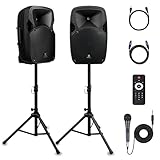 PRORECK Party 12 Powered PA System
A DJ is one of the biggest line items on any wedding budget. If someone you know can run a playlist, this is the difference between hiring one and not.
See it on Amazon →
PRORECK Party 12 Powered PA System
A DJ is one of the biggest line items on any wedding budget. If someone you know can run a playlist, this is the difference between hiring one and not.
See it on Amazon →
 Amazon Basics 46,000 BTU Patio Heater
Outdoor evening receptions live or die on this. Renting three for a night often costs more than buying two.
See it on Amazon →
Amazon Basics 46,000 BTU Patio Heater
Outdoor evening receptions live or die on this. Renting three for a night often costs more than buying two.
See it on Amazon →
 DazzlingStage Wireless Battery Uplights (6)
Battery uplights need no cable runs, so a venue that bans taped-down leads still lets you use them. The cheapest thing that changes how a room photographs.
See it on Amazon →
DazzlingStage Wireless Battery Uplights (6)
Battery uplights need no cable runs, so a venue that bans taped-down leads still lets you use them. The cheapest thing that changes how a room photographs.
See it on Amazon →
 Efavormart 8 ft Gold Hexagonal Arch
Heavy-duty metal rated to 100 lbs, and it resells afterwards, which is the part hiring one never does.
See it on Amazon →
Efavormart 8 ft Gold Hexagonal Arch
Heavy-duty metal rated to 100 lbs, and it resells afterwards, which is the part hiring one never does.
See it on Amazon →
 Nervure Gold Dinnerware Set, 350 Pieces
 JEVERGN Gold Charger Plates, 13 in (24 Pack)
 Clear Glass Votive Candle Holders (24 Pack)
 Velvet Silk Artificial Roses (50 Count)