Calculate exactly how many wedding invitations to order based on your guest list. Avoid over-ordering and wasting money, or under-ordering and scrambling for more.
By WeddingBudgetCalc Team · Last updated January 6, 2026
6 min read
Count every person, including children
Married couples, partners living together
Families with children at home
The four rentals worth buying instead
Most wedding advice is about trimming the flowers. These four are the line items where buying outright costs less than one night of hire, and three of them resell afterwards.
One of the most common mistakes couples make is ordering one invitation per guest. But wedding invitations don't work that way—they're addressed to households, not individuals. Understanding this distinction can save you hundreds of dollars on stationery.
When calculating invitation quantities, think in terms of "addresses" or "households" rather than headcount. A married couple receives one invitation, even though they're two people. A family of four living together receives one invitation. Only single guests living alone receive individual invitations.
Counting Households vs. Guests
Here's how to think about your guest list:
Married couples: 2 guests = 1 invitation
Couples living together: 2 guests = 1 invitation
Dating couples (separate addresses): 2 guests = 2 invitations
Family of 4: 4 guests = 1 invitation
Single adult: 1 guest = 1 invitation
College student living at home: Included on parents' invitation
College student living away: May warrant separate invitation (etiquette varies)
Quick Estimate: If you don't want to do detailed calculations, a typical guest list converts to invitations at roughly 60-70%. So 100 guests usually means 60-70 invitations. But use our calculator above for a more accurate number.
Why You Need Extra Invitations
Never order the exact number of invitations you need. There are several reasons to build in a buffer:
Addressing Mistakes
Hand-addressing 70 envelopes means you'll likely make at least a few errors. Smeared ink, misspelled names, and wrong addresses happen. Having extras means you don't have to live with mistakes or wait for a reorder.
Printing Issues
Even professional printers occasionally produce pieces with imperfections—slightly off-center text, ink spots, or paper damage during cutting. Having extras lets you discard any imperfect pieces.
Last-Minute Additions
Guest lists change. You may add people after invitations are printed—a new significant other, a reconciled family member, or someone you initially forgot. Extra invitations prevent awkward conversations with your stationer.
Keepsakes
You'll want to keep an invitation for your wedding album. Your parents may want one too. Maybe grandparents. Plan for at least 3-5 keepsake invitations that never get mailed.
Lost Mail
Despite your best efforts and correct addresses, some invitations will get lost in the mail. Having extras means you can quickly resend rather than waiting for a reorder.
The standard recommendation is to order 15-20% more invitations than you need. For most guest lists, this means an extra 10-15 invitations. The cost of extras is minimal compared to the hassle of needing more.
Complete Invitation Suite Quantities
A wedding invitation suite includes more than just the invitation itself. Here's what you typically need:
Main Invitations
The primary invitation card with your event details. Order enough for all households plus your buffer.
RSVP Cards
Traditional etiquette calls for one RSVP card per invitation, regardless of household size. A couple uses one card to respond for both people. Order the same quantity as invitations.
RSVP Envelopes
Pre-addressed, pre-stamped return envelopes significantly increase response rates. Guests appreciate not having to find a stamp or look up your address. One per invitation.
Outer Envelopes
The main mailing envelope. Order 10-15 extra beyond your invitation count for addressing mistakes.
Inner Envelopes (Optional)
Traditional formal invitations include an inner envelope listing exactly who's invited (helpful for specifying "Mr. and Mrs. Smith" vs "The Smith Family"). Modern couples often skip these to save money and paper.
Additional Inserts
Depending on your wedding, you may need:
Reception cards: If ceremony and reception are at different locations
Directions cards: Maps or driving directions (less common now with GPS)
Accommodation cards: Hotel block information
Weekend event cards: Details about rehearsal dinner, morning-after brunch
Website cards: Your wedding website URL for full details
Invitation Timeline
Timing matters as much as quantity. Here's when to handle each step:
6-8 Months Before: Order Invitations
Give yourself plenty of time for design decisions, proofing, printing, and any revisions. Custom letterpress or foil invitations may take 8+ weeks to produce.
3-4 Months Before: Finalize Guest List
You need confirmed addresses before you can address invitations. Give yourself time to track down any missing or outdated addresses.
8-10 Weeks Before: Begin Addressing
Hand-addressing takes time. Start early, especially if using a calligrapher. Allow 2-4 weeks to complete addressing.
6-8 Weeks Before: Mail Invitations
Standard wedding invitation mail timing. For destination weddings, mail 10-12 weeks ahead to allow for travel planning.
3-4 Weeks Before: RSVP Deadline
Set your RSVP deadline 3-4 weeks before the wedding. This gives you time to follow up with non-responders and finalize your count for caterers.
Pro Tip: Take one complete invitation suite to the post office and have it weighed before buying stamps. Square invitations and heavy paper may require extra postage. Nothing's worse than invitations returned for insufficient postage.
Save Money on Wedding Invitations
Wedding stationery can cost anywhere from $100 to $2,000+ depending on your choices. Here's how to control costs without sacrificing style:
Digital RSVPs
Skip physical RSVP cards in favor of online responses. This saves on card printing, return envelope printing, and return postage—easily $100-200 for a mid-sized guest list. Include your wedding website URL where guests can respond.
Standard Sizes and Shapes
Square, oversized, or oddly-shaped invitations require extra postage (sometimes $0.30-0.50 more per piece). Stick with standard rectangular dimensions that fit regular first-class stamps.
Fewer Inserts
Consolidate information onto fewer cards. Your wedding website can host accommodation details, directions, and event schedules—no need to print separate cards for each.
Digital Printing
While letterpress, foil stamping, and engraving are beautiful, digital printing has come a long way and costs a fraction of the price. Many guests won't notice the difference.
Skip Inner Envelopes
Inner envelopes are a holdover from when mail delivery was less reliable. They're purely traditional and add cost without adding function.
Order in Bulk
Most stationers offer better per-piece pricing on larger orders. If you're close to a pricing break, ordering a few extra may actually save money.
Frequently Asked Questions
For 100 guests, you typically need 60-70 invitations since couples and families share invitations. Order 15-20% extra (around 80-85 total) for addressing mistakes, printing imperfections, keepsakes, and last-minute additions. The exact number depends on how many couples, families, and single guests are on your list.
Count households, not individual guests. Each couple receives one invitation regardless of whether they're married or dating (if living together). A family with children living at home receives one invitation addressed to "The [Last Name] Family." Only single guests living alone receive individual invitations.
Order 15-20% extra invitations beyond what you need. This covers addressing errors, printing imperfections, last-minute guest additions, keepsakes for yourselves and parents, and occasional lost mail. For 70 required invitations, order 80-85 total. The small extra cost is worth avoiding the hassle of reordering.
Mail wedding invitations 6-8 weeks before your wedding date for local weddings, or 10-12 weeks for destination weddings requiring travel arrangements. This gives guests enough time to plan while keeping your wedding fresh in their minds. Set your RSVP deadline 3-4 weeks before the wedding.
Physical RSVP cards with pre-stamped return envelopes are traditional and get the highest response rates. However, many modern couples use online RSVP websites instead, which save money on printing and postage while making tracking responses easier. If using physical cards, include one per invitation regardless of household size.
Wedding invitation costs range from $1-2 per suite for digital printing to $10-20+ per suite for letterpress, foil, or custom design. For 75 invitations, expect $150-300 for budget options, $400-750 for mid-range, or $1,000-2,000+ for luxury. Add $100-200 for postage (both outgoing and RSVP return).
Inner envelopes are traditional but optional. They were historically used because mail was handled roughly, but modern mail is more reliable. Skipping inner envelopes saves money and is environmentally friendly. If you use them, the inner envelope lists who's specifically invited while the outer envelope shows the mailing address.
If children are invited, address to "The Smith Family" or "Mr. and Mrs. Smith and Family." If only certain children are invited, list them by name on an inner envelope or include a note. If children are not invited, address only to the parents—don't add "and Family" or list children's names.
Take one complete invitation to the post office and have it weighed before buying stamps. Standard letter rate works for lightweight, standard-sized invitations. Square invitations, heavy paper, or multiple inserts may require additional postage. Non-machinable surcharges apply to certain sizes and rigid inserts. Also budget for return postage on RSVP envelopes.
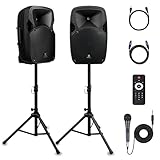 PRORECK Party 12 Powered PA System
A DJ is one of the biggest line items on any wedding budget. If someone you know can run a playlist, this is the difference between hiring one and not.
See it on Amazon →
PRORECK Party 12 Powered PA System
A DJ is one of the biggest line items on any wedding budget. If someone you know can run a playlist, this is the difference between hiring one and not.
See it on Amazon →
 Amazon Basics 46,000 BTU Patio Heater
Outdoor evening receptions live or die on this. Renting three for a night often costs more than buying two.
See it on Amazon →
Amazon Basics 46,000 BTU Patio Heater
Outdoor evening receptions live or die on this. Renting three for a night often costs more than buying two.
See it on Amazon →
 DazzlingStage Wireless Battery Uplights (6)
Battery uplights need no cable runs, so a venue that bans taped-down leads still lets you use them. The cheapest thing that changes how a room photographs.
See it on Amazon →
DazzlingStage Wireless Battery Uplights (6)
Battery uplights need no cable runs, so a venue that bans taped-down leads still lets you use them. The cheapest thing that changes how a room photographs.
See it on Amazon →
 Efavormart 8 ft Gold Hexagonal Arch
Heavy-duty metal rated to 100 lbs, and it resells afterwards, which is the part hiring one never does.
See it on Amazon →
Efavormart 8 ft Gold Hexagonal Arch
Heavy-duty metal rated to 100 lbs, and it resells afterwards, which is the part hiring one never does.
See it on Amazon →


